
Commercial Security Fence Installation in Northern Virginia | Super Fabrications
Commercial Fence Installation
Expert Commercial Fence Installation Company
Super Fabrications provides commercial fence installation for businesses, warehouses, industrial facilities, and commercial properties across Northern Virginia, Maryland, and Washington, DC. A commercial security fence is not a product you order off a shelf. It has to match how a site is used, where people and vehicles move, and what the property needs to keep out. That is why we treat every project as a planning exercise first and an installation second.
We install steel, aluminum, chain link, and anti-climb perimeter systems, and we coordinate the whole job the way commercial clients expect: a defined scope, a realistic schedule, and clear communication from the site walk to the final inspection. Whether you manage a distribution center that runs around the clock or a public-facing campus that needs to look presentable, we build fencing that holds up and does its job.
Request a Free Security Assessment →
Commercial Security Fencing Solutions
A commercial security fence is a perimeter system designed to control access, deter intrusion, and protect people and assets on a business or institutional property. Standard boundary fencing marks a line. A security fence is built to slow down or stop someone who is actively trying to get in, and to make monitoring the perimeter easier for whoever runs the site.
Businesses usually move up to a higher-security system when the property carries real exposure. A few common triggers we hear from clients:
- Property and asset protection for equipment yards, fleet parking, inventory, and stored materials.
- Controlled access so only authorized staff, vehicles, and deliveries reach the site, often paired with automated gates.
- Theft and vandalism prevention at sites that sit empty overnight or on weekends.
- Liability reduction by keeping the public away from hazards like machinery, retention ponds, or utility equipment.
- Facility security and compliance where a lease, insurer, or regulatory requirement sets a minimum standard for the perimeter.
If you want the broader background on how these systems protect a business, our guide on how commercial security fencing protects your property walks through the fundamentals in more detail.
Commercial Security Fence Types We Install
The right system depends on the balance you need between security, visibility, and appearance. Here is how we match each type to real commercial situations.
Anti-Climb Fencing
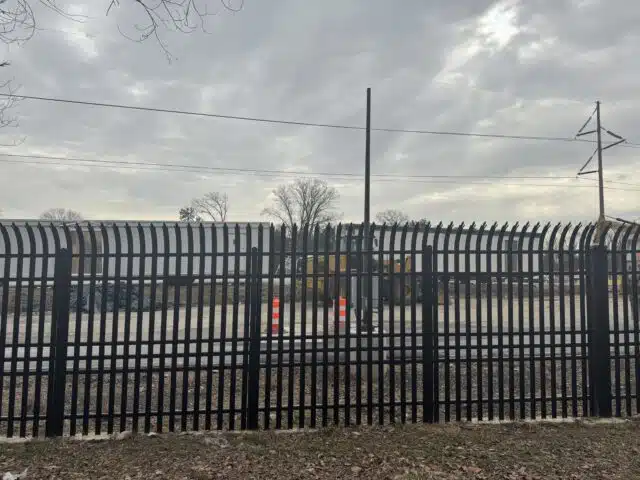
Anti-climb systems use tightly spaced mesh or vertical pales that give almost no foothold and no easy cutting point. They are the right call for high-risk perimeters where the main threat is someone trying to scale or breach the line: utility substations, industrial storage yards, data and telecom sites, and secured lots. Because the openings are small, they also block hand and tool access from outside the fence.
Ornamental Steel Fencing
When a property has to look professional and still hold a firm perimeter, ornamental steel is usually the answer. It suits office buildings, commercial campuses, schools, and any public-facing facility where a chain link line would undercut the image. Steel gives you the strength and rigidity of a security fence with a finished, architectural appearance, and it carries automated gates and access hardware cleanly.
Chain Link Security Fencing
Chain link remains the workhorse of commercial fencing because it covers long runs affordably and takes decades of wear. We install galvanized systems for maximum corrosion resistance and vinyl-coated options where a cleaner look or color match matters. Heights, gauge, and top treatments can all be specified to the site. It is a strong fit for warehouses, contractor yards, parking areas, and construction perimeters. You can read more about material and application details on our chain link fence installation page.
Perimeter Security Systems
Larger sites rarely need just a fence. They need a perimeter plan: where the line runs, where vehicles enter, how deliveries are separated from staff, and how access is controlled at each point. We integrate fencing with automated gates and controlled entry so the perimeter functions as one system instead of a fence with a gate bolted on. That coordination is where a lot of commercial projects either succeed or create daily headaches.
Industries We Serve as a Commercial Fence Contractor
Fencing needs shift a lot from one industry to the next, and the planning changes with them.
- Warehouses and distribution centers need durable perimeters and gates that keep trucks moving without slowing dock operations.
- Manufacturing and industrial sites often combine anti-climb fencing with controlled access to protect equipment and separate hazardous areas.
- Schools and municipal properties balance a secure boundary with an approachable look and safe, clearly defined entry points.
- Government facilities and utilities demand robust, tamper-resistant perimeters and, in many cases, compliance with specific site standards.
- Commercial campuses, office buildings, and retail properties lean toward ornamental steel that protects without feeling like a fortress.
Our Commercial Fence Installation Process
Commercial projects run smoothly when the planning is done up front. Here is how we manage a job from first contact to handover:
- Site consultation. We walk the property, review access points, terrain, and existing conditions, and listen to how the site actually operates.
- Security assessment. We identify the real risks and vulnerable points so the fence solves the problem in front of you, not a generic one.
- Material recommendations. We match fence type, height, and gate hardware to your security level, appearance goals, and budget.
- Project planning and scheduling. We confirm scope, coordinate any permits, and set a timeline that works around your operations.
- Installation. Our crews install the system to the agreed specification, keeping the site orderly and access open where you need it.
- Final inspection and walkthrough. We verify the line, gates, and hardware operate correctly and review the completed work with you.
Ready to map out your perimeter? Schedule your free security assessment and we will bring the planning to your site.
Choosing the Right Commercial Security Fence
There is no single best fence for every commercial property. The right choice comes down to weighing a few factors against each other:
- Security requirements. How hard does the perimeter actually need to be? A storage yard and a public school sit at very different points on that scale.
- Property type and visibility. Some sites want to see through the fence for monitoring; others want a solid, harder-to-breach line.
- Durability and maintenance. Galvanized steel and aluminum shrug off weather with little upkeep, which matters over a fence’s full life.
- Access requirements. Vehicle gates, pedestrian entries, and delivery flow shape both the fence layout and the gate hardware.
- Budget and long-term value. A cheaper fence that needs replacing sooner rarely wins on total cost.
During the assessment we walk through these trade-offs with you so the decision is based on how your site runs, not guesswork.
How To Evaluate Commercial Fence Pricing
Every commercial quote is specific to the site, so we do not publish flat prices. These are the factors that move a commercial fence budget up or down:
- Property size and total linear footage of fence line.
- Fence type and material, from chain link through ornamental steel and anti-climb systems.
- Security level and height, including anti-climb features and top treatments.
- Gates and access control, especially automated vehicle gates and entry hardware.
- Terrain and site conditions such as slope, rock, or existing structures to work around.
- Custom requirements and permits tied to the property or local jurisdiction.
Why Businesses Choose Super Fabrications
Commercial clients keep coming back to us because we handle the whole job, not just the fence line. Our crews install to the agreed specification and we coordinate the project so it fits around your operations. Materials are chosen for durability, gates and access hardware are set up to work reliably, and we keep you informed from the site walk through final inspection. For businesses that want a single contractor to plan, install, and stand behind a complete perimeter, that end-to-end coordination is the difference.
Serving Northern Virginia, Maryland and Washington, DC
We install commercial and specialty commercial fence systems for businesses across Northern Virginia, Maryland, and the Washington, DC area, including high security fence work in Washington DC and the surrounding counties. Working across this region day in and day out means we know the local permitting and site conditions that shape a commercial project, which keeps schedules realistic and avoids surprises late in the job. You can see the full range of what we do on our fence and gate installation site.
Commercial Fencing Portfolio
Request Your Free Commercial Security Assessment
If a secure, well-planned perimeter is on your list this year, the best next step is a conversation about your site. Tell us how the property is used and what you are trying to protect, and we will recommend a fencing system that fits the operation and the budget. Request your free commercial security assessment and we will get the planning started.
Frequently Asked Questions
What is a commercial security fence?
A commercial security fence is a perimeter system built to control access and resist intrusion at a business, industrial, or institutional property. Unlike a basic boundary fence, it uses stronger materials, harder-to-breach designs, and controlled entry points to protect people and assets.
What type of security fence is best for commercial properties?
It depends on the site. Anti-climb steel suits high-risk industrial and utility perimeters, chain link is a durable, cost-effective choice for warehouses and yards, and ornamental steel works best where appearance matters, such as campuses and offices. A security assessment is the right way to match the fence to your needs.
What industries benefit from commercial security fencing?
Warehouses, distribution centers, manufacturing and industrial sites, schools, municipal and government facilities, utilities, commercial campuses, office buildings, and retail properties all rely on commercial security fencing, each with different priorities for access, visibility, and durability.
Can commercial security fences include automated gates?
Yes. We regularly integrate automated vehicle and pedestrian gates with commercial fencing so the perimeter and access control work as one system. Automated gates are especially valuable for sites that manage regular truck traffic or need to limit entry to authorized users.
What factors affect commercial fence installation costs?
Total footage, fence type and material, security level and height, gates and access control, terrain, custom requirements, and permit needs all influence the final cost. Because these vary by site, every commercial project is quoted individually.
How long do commercial fence projects take?
Timelines depend on project size, fence type, permitting, and site conditions. A straightforward perimeter can move quickly, while larger installations with automated gates and custom work take longer. We set a realistic schedule during planning and coordinate the work around your operations.
Do commercial fence projects require permits?
Many do, depending on the jurisdiction, fence height, and property type. We factor permitting into the planning stage so it does not stall the schedule, and we work with the requirements of the local area we are installing in.
How do I request a commercial security assessment?
Reach out through our contact page or call our team, and we will schedule a site visit. During the assessment we review your property, identify security priorities, and recommend a fencing system with a clear, itemized estimate.
