
By Ray, owner — VA Class A contractor
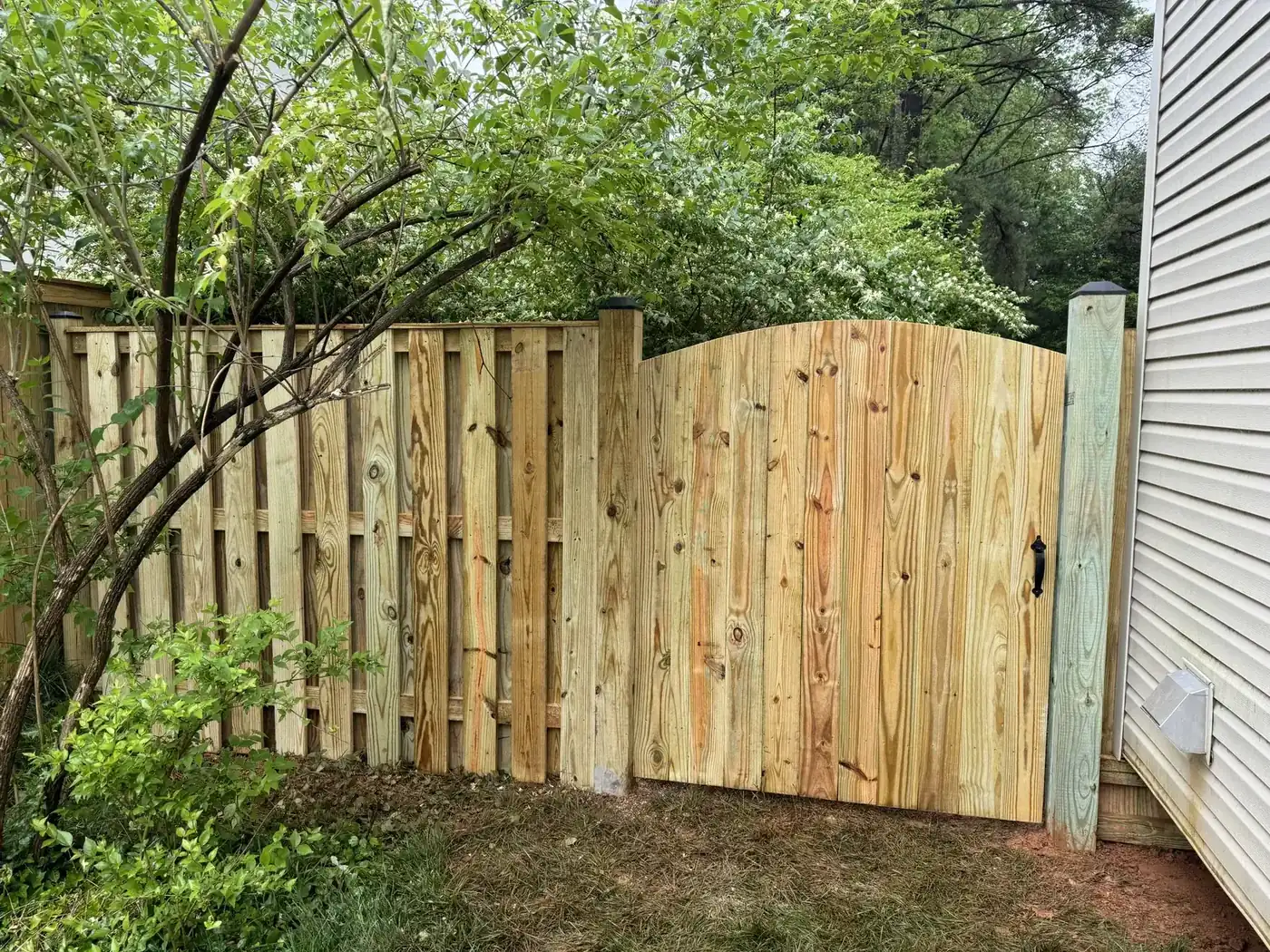
Every solid privacy fence has an ugly side — unless it is a shadowbox. By alternating boards across the rails, the shadowbox gives both properties the same finished face, breathes in the wind, and settles the oldest argument in fencing: whose side gets the good look. Here is how the design works and where it earns its place.
How does the alternating board pattern work?
Boards mount on both faces of the rail frame, with each board overlapping the gap beside its neighbor on the opposite side. From either yard you see a rhythmic series of boards and soft gaps rather than a flat wall — and both yards see the same thing. There is no front and no back, which is exactly the point. The pattern takes slightly more lumber and more layout than a single-sided run, and it repays both in how it lives on a shared line.
Why does airflow matter on a privacy fence?
A solid fence is a sail. Summer storm fronts roll through Northern Virginia with enough force to test any run, and a fully solid face takes the full load on every post. The shadowbox's gaps bleed that pressure through the line — a gust that hits a solid fence like a wall hits a shadowbox like a screen — which is gentler on posts and footings over the years. The gaps also help the fence itself dry after rain: boards that dry evenly stay straighter and take stain more uniformly than boards that stay wet on one face.
What does "finished both sides" mean for neighbors?
It ends the good-side-versus-bad-side problem. Most codes, including the Town of Vienna's §18-410, require the finished side of a fence to face the street and adjoining properties — a rule written for single-sided fences that can be awkward to satisfy mid-block. A shadowbox satisfies it by construction: every side is the finished side. When a fence sits directly on a shared property line, that symmetry is worth as much as the privacy. We build these along Vienna lots regularly, and the pattern suits the town's rules naturally — see our Vienna fence company page for how the codes shape local builds.
Where does a shadowbox earn its keep?
Shared property lines first — anywhere two yards meet and both owners will look at the fence for the next twenty years. Rear lines back onto trails and common space are another fit, where airflow keeps the run steady in open wind. It also suits owners who simply refuse to hand their neighbor the unfinished side of a new fence — an argument fence-builders rarely settle and a shadowbox avoids entirely. Where it is not the answer: tight side yards where maximum screening matters more than symmetry, and front runs under town height caps where a low picket does the job better.
How do you keep the pattern straight over a long run?
The alternating pattern lives or dies on layout. Boards set from a string line stay in rhythm for two hundred feet; boards set by eye drift, and a drifted rhythm shows from the street even when every board is perfect. We lay out the pattern before the first board goes up, check it at every third or fourth post, and let the posts — not the boards — absorb changes in grade. Done that way, the fence reads as one steady weave from end to end.
How does a shadowbox age compared to a solid fence?
Evenly, on both faces — which is the quiet advantage. A single-sided fence weathers differently front and back, so the "bad" side drifts further from the good one every season. A shadowbox grays uniformly and takes a re-stain uniformly, and the small gaps between boards read as design from day one, so shrinkage never turns into a flaw. As green zhang put it in a review posted on Google after a backyard build: "Thank you Ray and team for my backyard fence installation well done, very professional and customer oriented." Even weathering keeps a fence worth admiring.
Curious whether a shadowbox suits your line? Call (888) 820-6099 or send an estimate request — we will walk the boundary and show you the pattern on your own sightlines. More on the material itself lives on our wood fence installation page.