
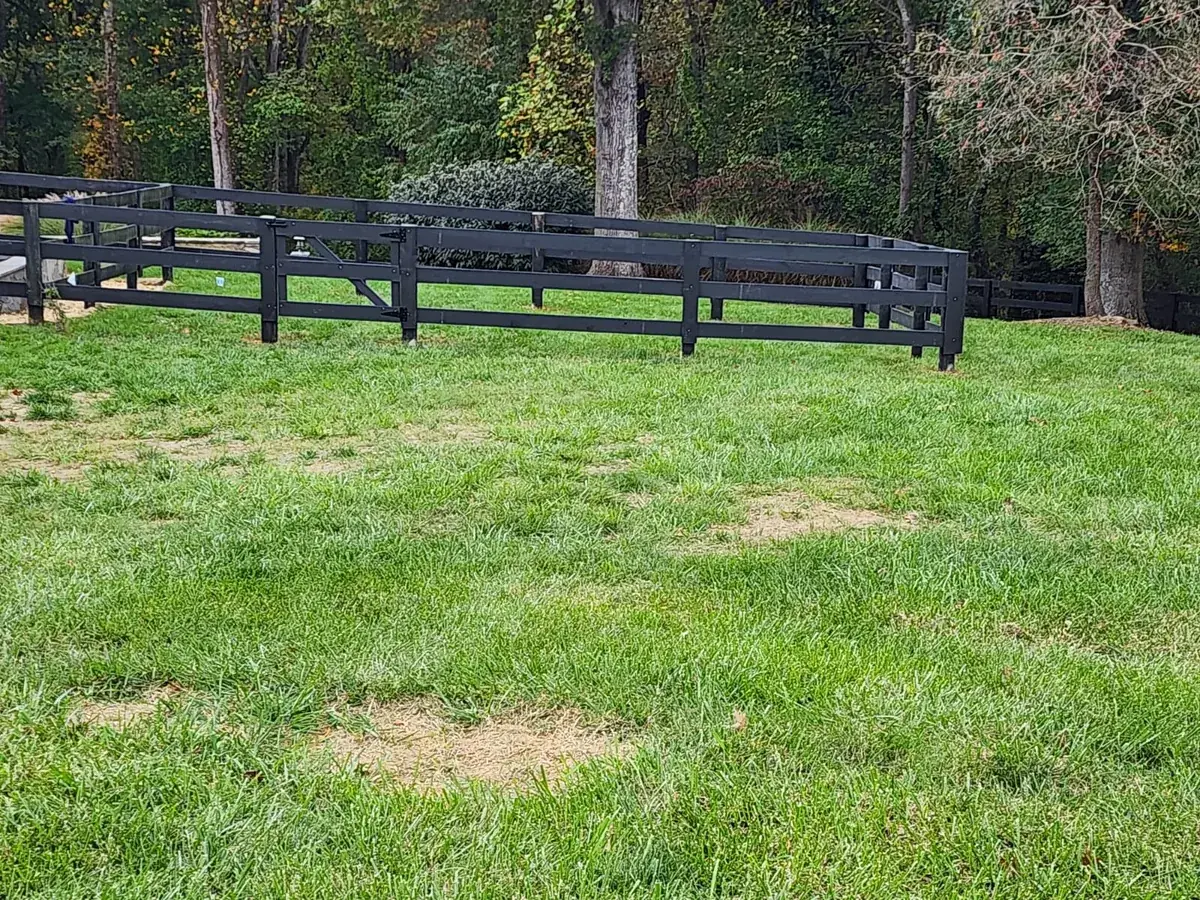
West of Ashburn the lots open up and the work changes. A horse property asks a fence to do two jobs at once: hold the horses where they belong and keep the deer out of what the horses do not eat. Fencing Loudoun County acreage is a different trade than fencing a Fairfax courtyard. Here is how we approach it.
Why does equestrian property fence differently?
Three reasons. Containment: a horse leans, kicks, and tests a line in ways a dog never will. Access: paddocks need gates wide enough for tractors, hay wagons, and trailers, not just people. And scale: a run that is 150 feet in a subdivision is a short afternoon here — paddock lines run hundreds of feet across open ground, so material choice and post spacing carry real weight. Deer pressure is the second client, in a way: the same property that contains horses also grows gardens and ornamentals that deer treat as a buffet. We plan around all of it at the free on-site walk.
What is black ranch rail, and why does it work?
Black ranch rail is the profile you see along the fields west of the town lines: horizontal rails on substantial posts, standing about four feet, with the whole line visible from a distance. Black works here for practical reasons, not fashion — a dark line reads clearly against green fields in low sun, which is exactly when horses and drivers need to see it. It defines a paddock without blocking the view that makes the property worth owning. It also asks little: no staining cycle, and hardware that shrugs off weather. For the profiles and options, see our ranch rail and deer fencing page.
What about crossbuck and farm gates?
Crossbuck is the two-rail X pattern that reads as "farm" from the road. Owners choose it at entries and along drives, where the fence is as much a face as a boundary. White and black both work; the choice usually follows the house trim. A matching crossbuck farm gate carries the same look across a gravel drive — and on a horse property, gates are the daily hardware. We size them for the equipment that uses them, hang them to latch true, and set those gate posts stiffer than the line, because a gate is the part of the fence that moves.
How tall should deer netting run?
Taller than people expect. Deer clear low lines with ease, which is why a paddock fence alone never protects a garden. Deer netting usually stands well above ranch rail — often seven feet or taller — because the point is not to look nice, it is to be a jump a deer will not attempt. Netting suits gardens, orchards, and landscaped beds, and it sits quietly against a tree line in a way rail cannot. A common plan on larger properties: black ranch rail for the paddocks and frontage, netting around the garden and any planting the deer have already found.
What keeps horses safe along the line?
Visibility first: horses respect a fence they can see, and rail gives them that. Rail spacing and count then matter — a configuration a horse cannot hang a leg through. No sharp edges, no protruding hardware on the horse side, and latches a rider can work from the saddle. Gate widths set for the farrier's truck and the hay delivery, not just the lawn tractor. And posts set to carry a 1,000-pound animal that leans on the fence because the grass is greener on your side of it.
What does an install look like out here?
Long runs build rhythm. The crew sets posts along the line first, then follows with rails, then hangs gates last so nothing gets trapped inside a paddock. Corners carry the load on an open run, so they get the bracing. We stage materials where they will not fight the mowing schedule, and we leave the gate widths where the equipment needs them. See our Loudoun County fence company page for the area details, then call (888) 820-6099 for a free on-site estimate — and we will walk the paddocks with you.